
I feel a rant coming on.
I could never be categorised as a model pupil at school. Still, I can remember my home economics teacher saying, ‘A high-quality garment will have strong hemming, seams, and buttonholes.’ In my four years at secondary school, there was so much learning I could have retained, but for whatever unknown reason, the details of strong hemming, seams, and buttonholes stuck in my memory.
This article isn’t about my time at school; it is about how one assertion, which in the first instance may seem inconsequential, holds significance and highlights how we as people have changed. And all this came to me in a search for lace fingerless gloves, an innocuous endeavour.
To source the gloves, I had to leave the island. I visited Westport, Castlebar and Galway, but my search was fruitless. I had no option but to go online. As usual, the magic of the professional photographer significantly enhanced the appearance of the gloves, which were marketed online. It was evident upon receipt that they are not highly durable.
There was a time when it was considered important to dedicate time, energy, and expertise to crafting good-quality clothing. Quality was linked to self-respect. I recall my grandmother saying to me, ‘People may have had little money, but they took pride in themselves by polishing their shoes.’ Probably said in response to me going out in my unpolished Doc Martens. Once common, this outlook is now outdated. Today, mass production means we have surrendered to buying large amounts of clothing, much of which sags and comes apart after just a couple of washes.
At first glance, the plight of inexpensive clothing might appear totally unrelated to slow lane living. However, it is the author’s opinion that fast fashion is a bedfellow of life lived in urgency. There is little time to spend pondering over what to wear, and little time for complexities. Thus, we get up, get dressed and go. We are encouraged to buy, buy, buy, always in pursuit of the latest trend. Fashion houses and advertisers employ strategic and innovative methods to cultivate consumer demand by stimulating continual dopamine release associated with acquiring new products for legal markets of mass addiction. Exhausting.
Nowadays, functionalism is required rather than flair. Functionalism is valued for quick operation, making individuality less common. Additionally, it is more cost-effective to outsource our clothing industry to low paid nearly slaves, who tirelessly operate machines to the incessant speeding of fast-paced whirring. As time is money, there is little desire to create garments with strong hemming, seams and buttonholes. Complexity slows us down. Therefore, creating something similar tends to yield better results for manufacturers. And if you do wish strong hemming, seams and buttonholes, one must go upmarket, which will no doubt distress the piggy bank, but the whole process of purchasing will be done in the calming, slow beat of luxury.
Lampposts are no longer manufactured with beautiful, ornate designs, and cars are seldom seen in orange and yellow. We have lost colour and details that create prettiness. Kitchen equipment is often metallic grey. It’s fit for purpose and easier to maintain, a priority in modern living, but give me the old-fashioned fridge which burrs in the evening. I love the sound that it makes, it’s a reminder of the welcoming cheer of hearth, though perhaps I’m simply being nostalgic.
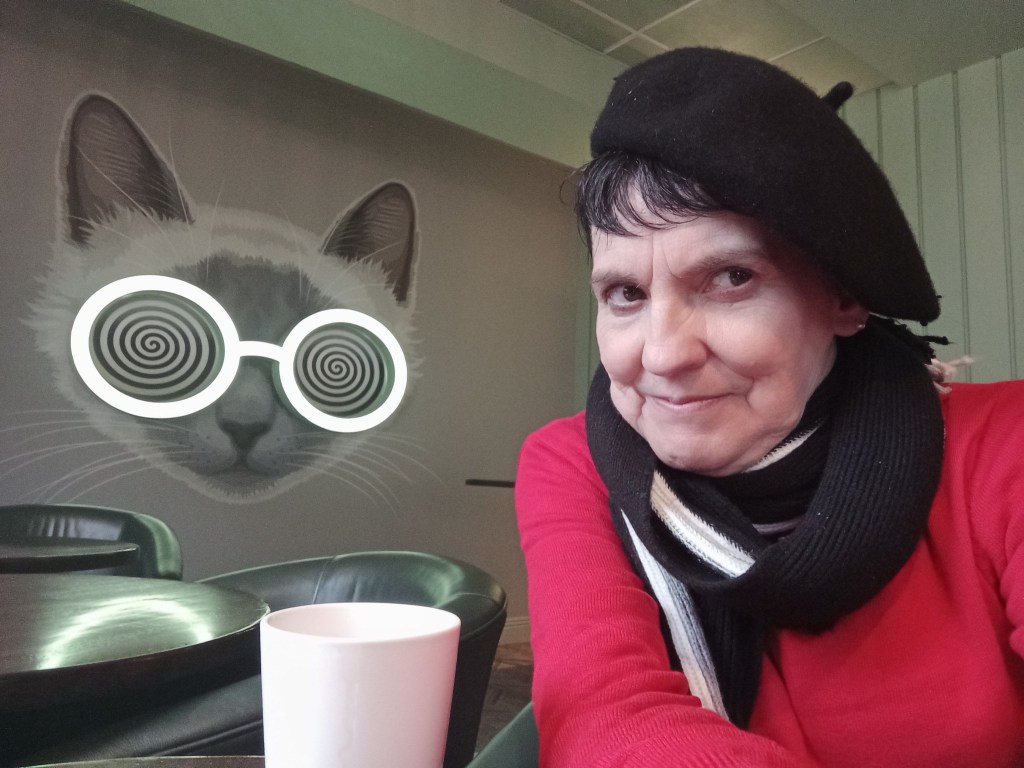
My style is not unconventional, it is rather commonplace; jackets, tops, jeans and dresses are my mainstays. It’s a wardrobe built through time, slowly one piece at a time. I do like to add fancy tights, lace fingerless gloves and hats – the accessory signature that marks me as ‘Rae’.
My youth was lived in a landscape of trends. Of course, there were distinct styles that were commonly worn, like puffed sleeve blouses and platform shoes. However, there was space for people who wanted to ‘rock their own style’, individuals who navigated the many cool offbeat subcultures. Unlike mass-market department stores of today, boutiques offered unique, one-of-a-kind, or limited-run items. Way back then, there were stores one could walk into and come out happy with something just a bit different.
I owned a pair of purple striped harem trousers when Oxford bags were in vogue. Harem trousers were baggy, elasticated at the top and drawn in at the ankle with an outward ruffle. Think – a trousers version of Andy Pandy’s dungarees. I loved those trousers; they told the story of fun, and there was the extra bonus of being the only person in my town who had them. Yeah, someone did shout ‘poser’ at me in the city centre of Glasgow, but I kept on wearing them. Why wouldn’t I? I wasn’t going to be intimidated by words.
I love daffodils; bright yellow, pretty, the sight of them is soothing balm for the soul. Now, what if God created only daffodils, and there were no other flowers, no roses, no snowdrops, no lilies? I don’t think I need to expound on this other than to write that while we may admire the yellow blooms, we would miss out on the awe and wonder of carpets of flowers in various varieties and shades. Thus, if God created us unique, each of us with our own exclusive fingerprints, why do we diminish ourselves into relative sameness? Humans are his wondrous creations, and we ought to ‘rock our personality.’ After all, our years are precious, and even if we live to three score and ten, life is too short to hide in the shadows.
Our younger years shape us, and it is no different when it comes to the story of our clothes. This tale is set in my hometown and happened when I was approximately fourteen years old. Oxfam opened as the first charity in the town, much to my delight. However, there was reluctance by many to enter the store, as assessed by the few people who used it. Perhaps the ethos of second-hand didn’t tally with the upper social mobility codes espoused by the locals, or maybe many had similar feelings to those of my mother, who grew up wearing hand-me-downs. She wanted new, unworn and fresh off the rails. Anyway, as a mere youngster who saw it through the lens of discovery, it was an Aladdin’s cave storing an eclectic mix of good-quality items.
One rainy day after school, sifting through the rails, I came upon a red cape with large ornamental buttons in blue, green, red, and yellow. In a wisp of a second, it came to me that the buttons would add character to an otherwise dull purple hessian bag I owned. I purchased the cape, cut off the buttons and sewed them on my bag. I gave the cape to a friend who made a waistcoat out of it. I was very fond of that bag, and time has elevated that bag as one of my favourites. Those buttons emphasised my daydreaming, whimsical nature and the purple hessian bag, my laid-back hippy vibe. I was granted the opportunity to discover who I might be in the world of garments.
Sadly, I would have to say that many modern-day charity shops have lost that exciting atmosphere of yesteryear. A wave of sadness comes over me when I see ornaments with chips and scratchy scruffs in footwear. That was never the ethos of that old Oxfam. Moreover, most charity shops nowadays just don’t have what I like. I don’t blame the charity shop for this, after all, they can only offer what people donate, and donations today will probably not have strong hemming, seams, and buttonholes, which means they may not have the staying power of yesteryear’s clothing, thus designed to be disposed of rather than passed on for donations.
I would be the first to admit that the past was not a rose-coloured utopia. I am aware that it is all too easy to romanticise the past. However, my lived experience on this Earth has shown me that everyday style has become blander, and sameness abounds. Strong hemming, seams and buttonholes suggest care and time, something classy, something to be valued. Do I not deserve more than flimsy and throwaway? If, like me, you prefer something a bit different from what the masses are wearing, one must go online, which upsets my ‘shop local’ heart. I would like to make it clear I’m not saying professions like the garda should ditch their uniforms, not all, that would be absurd. My concern pertains specifically to everyday social attire. Uniforms, on the other hand, serve a functional purpose by clearly indicating an individual’s role or identity; their clothing immediately communicates this information without ambiguity.
Oh, why so much conformity? Perhaps it is safer not to curate oneself and bear the offence of standing out. Maybe it shows wisdom by shielding oneself from barbed comments and the whispers of ‘who does she think she is.’ Maybe clothing today purely reflects our busy, busy, busy regime, and I should not expect anything else. Like fast food, to be eaten on the go, clothing is designed for us to open the wardrobe and go, go, go.
But let’s not forget that choice is rather limited and we are at the mercy of what the shops stock. I understand, it’s about supply and demand; thus, if there’s demand, supply follows. However, it could be argued that the systems in place to purchase clothing from suppliers necessitate that department stores must buy in large amounts, and items guaranteed to sell, so it is not viable to purchase smaller numbers, especially when ordering from overseas. This results in clothing which is similar in stores, so one must buy from what is available. This contrasts with the boutique, which can purchase smaller numbers of select items. The boutique can order fewer items, in an economy where many don’t have the income to purchase higher-end clothing, the owner is at the mercy of the department stores.
My rant is rather long, so I shall pause, look at the grey, soggy sky, grateful I do have enough clothes to wear, and I don’t need to be on the conveyor belt of fast fashion. I can navigate life slowly away from worldly systems that propel me to live life with speed,
Ah, my rant concludes.
In memoriam
Bus Stop, Franx’s, Gear, Lady Jane, Isobel and the boutique in Inverness whose name I forget.


 VR Stories