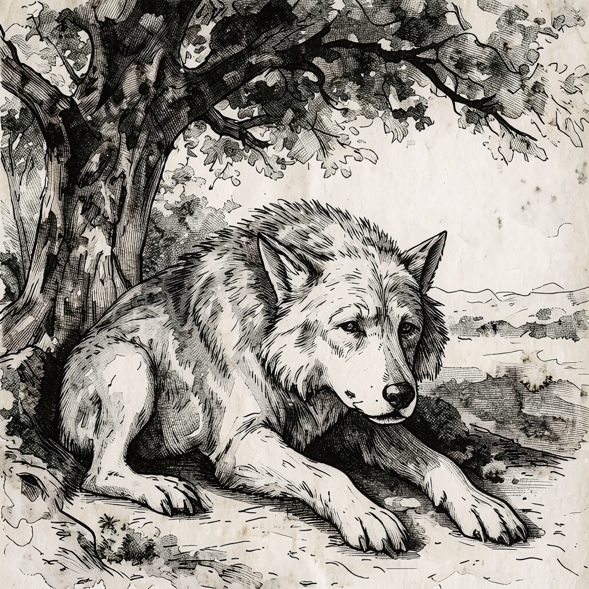
Achill Island has many sorrowful stories. A single tear of mist clings to the island, and the wind carries a sense of sadness that is almost audible. This tale of the wolf known as Rialta is considered a myth, but when we learn the history of a place—the quiet suffering, joyful moments, or ancient events that shaped the hills and rivers—the environment ceases to be merely a physical backdrop and becomes a living, breathing companion of living stories.
Rialta, the wolf cub, was born by Slievemore, on the island once known as Eagle Island. Although the birth of Rialta was indeed a joyous occasion, tears pricked her mother’s cheeks because her cub had a fur that was a breathtaking blend of cinnamon and creamy white, and she knew it would be prized by the hunter. For in Cromwellian Ireland, bounties were exceptionally high to encourage the eradication of the wolf, and a hunter could receive £5 to £6 for a pelt.
There was great uncertainty in the land; no longer did the trees converse happily with the sky. Now the wind groaned with the story of greed, and it sliced Rialta’s mother’s soul so much so that she felt sorrow for the human.
To appease the ravenous appetite of the new merchants, the land was enclosed and sold. Man, woman and child were removed from Achill and shunted into the bowels of the abyss in the new industrial cities where life moved to the rhythm of the clock rather than the seasons.
One morning, Rialta’s mother awoke to an ominous presence hanging in the air. She paused, the hair of her coat standing to attention. She sniffed and shouted, “Smoke.”
In the blink of an eyelid, the pack in a frenzied rush fled the wolf den. Rialta was grabbed by the scruff of her neck by her mother, who sped towards a nearby Fairy Pool and thrust Rialta into a little snug in the landscape. Then she ran to assist the other members of the pack.
Later, that evening, Rialta peeked shyly from the cave. Sadness weaved around her. It was then that Rialta learned about her mother’s passing. Many of the wolves had died in the fire. She was so overwhelmed by grief that she gave out a mighty howl which cracked the night air.
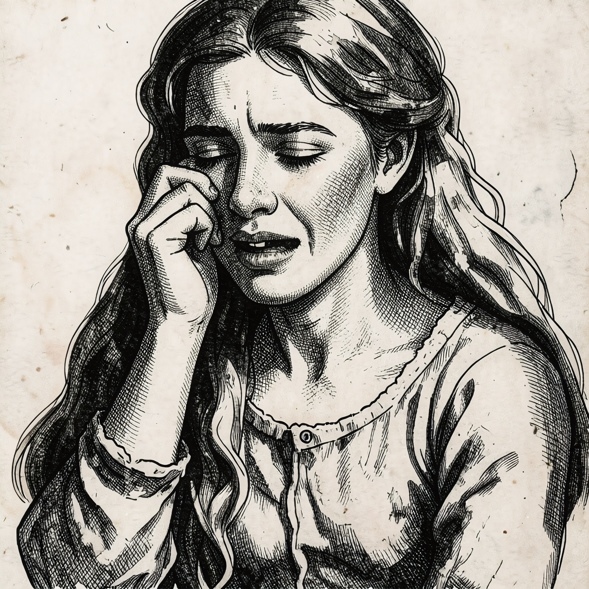
Great sorrow came upon her, and it propelled her further into the dark forest. She ran and ran until she could run no more and eventually toppled, exhausted, onto the ground under an old oak tree. While resting, she saw in the distance a maiden with hair as red as ripe cherries. She was sitting on a tree stump, and she was sobbing.
Although Rialta had been instructed about the devious ways of humans, they were best avoided. She sensed in her heart that this maiden was a kindred spirit. The maiden had the same sorrow as Rialta etched in her eyes. With one faltering step after the other, Rialta made her way towards her.
A cacophony of staccato sobs reverberated around Rialta, and they pained her. Rialta looked down at the girl with the round, sad eyes and discovered that she was a servant girl of the Laird and that her name was Meehan O’Malley, of the great sea-faring clan.
Meehan got no peace from the local Laird. He was cruel, and because she had rejected his advances, he worked her hard. Meehan had the same fierce nature as her ancestor Grace, daughter of the O’Malley chieftain – Owen ‘Dubhdara’ (Black Oak). She was adamant that her youth, her sensuality, was not open for barter to any man. She was determined to get back to her family home in Kildavnet. Her family would be deeply enraged with the way she was treated and knew that this could bring conflict to the island. Rialta and Meehan sat nursing their heartache, tunnelled in the fragments of blurred memories.
Meanwhile, in a droughty type of inn, the hunter McGrory was nursing his wrath with ale. It was he who caused the fire. He had hatched a plan to ignite what he thought would be a controlled fire to smoke Rialta out so he could capture her. His plan had failed; instead of Rialta’s soft coat, he only managed to get four plain grey ones, which fetched one pound less at market. He thumped his glass on the wooden table and resigned himself to the fact that he would resume the hunt in the spring.
Time passed, and soon the stirrings of Spring moved across the land. The increasing daylight hours began to soften the dramatic Atlantic backdrop, with the iconic gorse bushes turning the hillsides a vibrant yellow. One morning, Rialta and Meehan were sitting by a lough eating fresh berries and laughing. The sound of hooves in the distance interrupted their peace.
Both fixed their eyes on each other. McGrory, their relentless adversary, would soon fast on their heels. His presence was looming closer with every passing hour.”
The hooves’ vibration was getting louder and louder. Both Rialta and Meehan jumped to their feet and began to flee.
With whirling adrenaline and heaving breath, they ran and ran, and they ran until they came to the cliffs at Croaghaun on the West Wild Atlantic.
Rialta and Meehan looked at each other and smiled. With minds locked in mutual agreement, they took one firm step and leapt downwards and downwards into the warm embrace of the ocean.
When McGrory reached the cliffs and saw Meehan and Rialta had vanished into the sea, he was furious.
It is said that in their desperate pursuit to remain free, Rialta and Meehan did what only a wolf and an O’Malley woman would do—they ran, unbound, into the sea. It is also said that in times of eviction or trouble, a mysterious wolf and maiden with hair as ripe red cherries would make a ghostly appearance.
And today, there are times when the wind howls loudly, a strange figure of a maiden and a wolf can be seen in the deserted village by Slievermore. A haunting reminder of times passed on Achill Island.
 VR Stories