Author: Rae McKinlay

I am a comic artist/storyteller and Creative Practitioner. 2024 was a challenging year and so now I am taking time out by wintering in Achill Island. I write to try and make sense of things and that is what I am doing with this blog. .

The Benign Fairies of Murrevagh

This is a tale of long ago.  A time when the air was thick with a relentless, high-frequency roar that never truly slept. The wind, heavy with grime, swallowed the stories and the songs.  It was a time when the towns clanged with factories and noise.  The heavy, rhythmic thumping of metal stamping presses and the persistent whine of high-speed cutting machinery, a symphony of progress and production.  

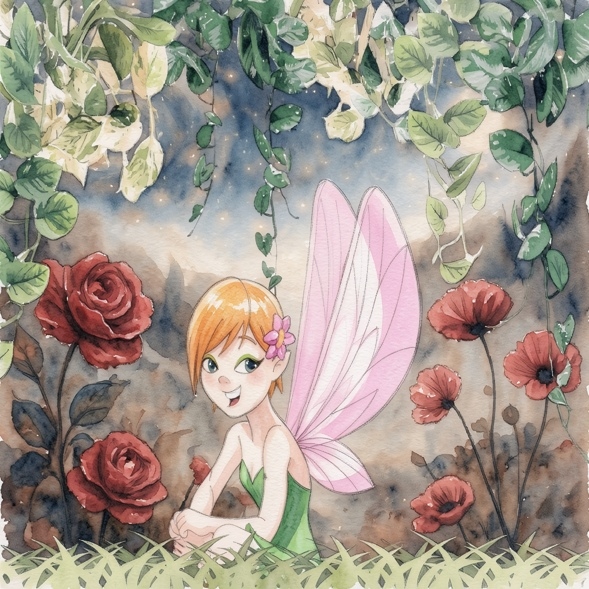
Petalkins of the sweet orange hair sat alone by the river. The cold bit into her bones.  The river no longer ran clear; it was layered with greasy oil.  The noise made her feel claustrophobic.  The once-tranquil pasture had been encroached upon by new builds and was now an industrial suburb of Manchester. Not even her fairy magic could stop the city’s rapid growth.  She gazed upwards and wondered whether the fluffy popcorn-shaped clouds, now invisible, could hear her thoughts.  She resigned herself to reality.  The old ways had gone, and they would never come back.

It was Petalkins who had first caught sight of Fairy Hawthorn, which had been cut to a stump when she had returned with the other faeries after visiting friends in Argyll.  Dear old Fairy Hawthorn, who had stood alone for 370 years, was gone. Nothing was sacred anymore, and few people believed in fairies.  Once, people were very wary of disturbing the fairy folk, and they were very much alive in speech and song. Petalkins gave out a heavy sigh as she lamented the once-upon-a-time days.

The orchard grasses, cornflowers, and ox-eyed daisies were also gone.  The once wild meadow that Petalkins and the other fairies had waltzed on had been plundered to make way for another new factory.  Now, if one threw a stone there would probably hit a factory.  

Fleta, the queen of the fairies, eyed Petalkins from the vantage point of the last oak by the river. Her heart banged. The felling of Fairy Hawthorn was indeed the last straw.  She took it as a sign that it was time to leave.   

Blobs of sweat popped on Petalkin’s palms, she felt her shoulders lock, her breath catching as her throat constricted.  Blackness came upon her, and she tumbled to the ground.  She awoke to the rosy-cheeked Fairy Layla peering down at her. She was the type of fairy who was comforting on a sad day.

             “You fainted, girl.” Fairy Layia said, with a look of concern on her face.

             “I’ll be fine in a minute; it’s all a shock.” Petalkins sighed.

Fairy Layla couldn’t hide her sadness. She told Petalkins to get ready, Queen Fleta had announced that all the fairies were setting out in the morning.

The next morning was a moody, broody type of day, and rain descended upon Petalkins. The familiarity of place would soon fade. She believed that too much change too fast was not conducive to anyone.  Change had a rhythm that offered reassurance with change.  Tears buckled behind her eyelids as she attempted to come to terms with the reality of leaving a place once called home.  Petalkins was another victim of industrial progress. 

This new Industrial Revolution brought in new ideas and a new way of living. Petalkins was appalled that life now rolled with machines.  Reason and logic were dominant ideologies, and the belief in fairies was dismissed as superstition; there was certainly no place for that in this new rational world. People were becoming less inclined to believe in fairies, and therefore, her body was withering, starving from the human belief that once fueled her existence.

It came time to leave, and all the fairies assembled by the last living oak, a living, solitary remembrance of a time before time.  They were all stone silent.

             “We have no place to call home now,” Queen Fleta declared.  “Belief in us is diminishing, and the constant, around-the-clock noise is causing me sleep deprivation and heightened irritability.  We are moving to the West Coast of Ireland; they still believe in faeries over there.”

Queen Fleta withdrew her gaze as her eyes watered, and for the first time in her life, she felt old.  Her bones now ached, and her heart was heavy. Mustering up the little strength she had, she flew up in the air, leading her troop to the West Coast of Ireland.

Timing could not be any worse.  It was the night of 6th January 1839, an event that would go down in history as The Night of the Big Wind.  The fairies were met with a severe hurricane-force storm that was devastating Ireland. The fairies locked arms against the gusty force, yet they continued to be tossed about.

Now it must be said that the West Coast of Ireland has its own indigenous ‘other folk.’ Unlike the fairies in Britain who have wings, in Ireland, the ‘other folk’ are wingless.

The leprechauns who lived in Achill Island were not too pleased when they discovered that a group of English fairies was going to settle in what they considered their territory.  Rooted in the dawn of time, they viewed interlopers with cold, unrelenting hostility

The thing about leprechauns is that they may be tricksters, but they are certainly not rash, and they arrive at decisions with great thought. With a simple plan to unleash the elements, they became enshrined in folklore as the authors of that night’s mighty storm

When Petalkins and the other fairies reached land, they dropped to the ground. The continual volley of slanting rain had cut into their flimsy clothing, causing bruising on arms and legs.  The thick, heavy icy droplets that had slammed down onto all the fairies’ hair made it look like rats’ tails.    

“I want to go home.” Fairy Layla sobbed.

But there was no home to go back to. 

Petalkins looked around, and all she could see were roofs snatched from thatched mud houses, and the area resembled a combat zone as far as her eye could see.  

At first light, the fairies began their search for a suitable tree to reside by.  It didn’t help that many of the trees had fallen, victims of the storm, and were sprawled out on the ground.  The ground was so wet that the worms had surfaced to breathe. Their soggy clothes stuck to their bodies, and dots of sticky sweat made them feel so uncomfortable.  Hours passed, but eventually they came across a solitary hawthorn in the middle of a field, its branches bare and barren. 

However, the Hawthorn did not welcome them like the Fairy Hawthorn back home. Instead, its branches dropped to the ground in a defiant gesture of unwelcome.   The fairies were bone weary and too tired for conflict, so they forcibly entered through its roots.   Tiredness came upon all, and they all fell asleep where they landed.

When early dawn arrived, the fairies woke to find a whole gang of leprechauns surrounding the tree.   Fear came upon them.  They had heard stories about the wrath of the Irish ‘wee folk without wings.’

Queen Fleta had become forlorn; her beaming smile had gone.  The loss of the place she loved had pained her so much that she had been rendered silent.  So, Fairy Layla took it upon herself to go out and try to appease the situation. 

             “We wish you no harm,” she said.  “We are homeless and have nowhere to go.   We are no threat to you.”

The leprechauns looked upon Fairy Layla with pity, and a short balding leprechaun called Red Bow stepped towards her and spoke.

             “You can stay for tonight, but in the morning you must go.  There is a place called Murrevagh just down the road where you can reside.”

And with those words, all the leprechauns disappeared within the blink of an eye.  It was at that point that the hawthorn tree lost its hostility towards the fairies and raised its branches upwards to the sky.  

             “My magic has returned!” Petalkins chimed, dancing on her toes.

             “So has mine,” declared Fairy Layla.  

In the morning, the fairies made their way to Murrevagh in Co. Mayo.  Petalkins’s eyes widened when she saw the chestnut trees and the deep-pink honey-scented heather.  The sense of home was beginning to settle into her bones.  She gazed across the dusky pink sky, a smile spanning her lips.  Soon, the sky would be alive with swallows, and sweet-smelling flowers would erupt from the hedgerows.   

The day was not without sadness.  Queen Fleta could not bring warmth into what she considered a landscape starkly unfamiliar and cold. Despite being surrounded by beautiful landscape, she felt stranded, mentally retreating to the comfortable, familiar routines of her old life.  Her heart could not hold this sadness, and she passed away surrounded by the faeries who loved her.

Petalkins, engulfed in muted shades of grief, felt hauntingly empty. The loss of her queen, the fairy who held all her secrets and anchored her through life’s storms, left a profound, aching void.  She stepped into the new home that she had made in one of the chestnut trees. She placed the kettle on the stove, and she did that without any magic. 

If you are of the good fortune to visit Murrevagh, which lies on the wild Atlantic west, and despite the fairies being known as benign, I would hereby caution you to be wise and respect their territory.  After all, it is always good to be kind.
Joanie of The Bog

This tale is bound in the swirls of ancient dream time, but it is also a story of today.   Word by word, I shall spin my story, and it goes like this.

One raven black night, I took a walk by the River Bandon.  The feeble moon had no brilliance to offer, no silvery light to guide my steps. A light grey mist hung over the river like chiffon. I wrapped my shawl tightly around my shoulders to shield myself from the cold air, which chilled my bones. Nothing stirred, nothing.  Deep, deep silence, interrupted solely by the eerie call of a solitary owl.  

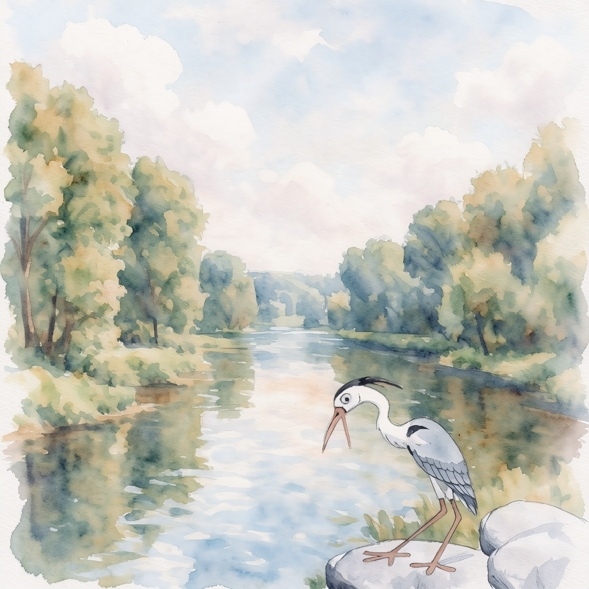
From the corner of my eye, I took in a heron with round coal-black eyes standing perfectly still on one leg. She cocked her head towards me; her fiery black button eyes burned deep into my soul.  I hurried by. 

Sadness tugged my heart; the old weir was gone, and now standing on the bank, an iron monster, silent, resting from its daily labour of constructing a flood defence system. Despite being the only person in the vicinity, I could not shake off the sensation that I was not alone.  I could feel icy breath against my ear, but when I turned around, no one was there. I continued, and the rhythmic slap-slap-slap of my soles echoed in the quiet street.  

Then, in the shadows by the old bridge, I saw her.   A long, tall, gangly woman dressed in mid-grey with straggly strands of white hair peeking out from her hood.  I could not make out her face; it was too well concealed. 

As I observed her, I noted that her limbs were unusually long and bent in all directions.  Strange as it may seem, something was appealing about her, something which drew me towards her. So, I trailed her. I followed her through the dank haze. I felt the dampness on my hair and eyebrows. The aroma of her scent, rich and earthy, bewitched my nostrils, soothing my tensed body.  

The old woman stepped onto an old, crooked path which was overgrown with a tumultuous tangle of nettles. I was totally surprised; I had never seen this path before, despite living in the town for several years.  Webs dangled like elastic sticky threads of hair from an old hag, of a Grimm’s fairy tale.   I forced my legs forward, fighting through the adrenaline surge and the frantic, buzzing static in my brain.

Then, much to my astonishment, moonlight began to break through, bathing the path in shimmery silver; the landscape sparkled. I was entering a new and unfamiliar world.  Perhaps, I should have just returned home at this point, but against my better judgment, I wanted to find out more about the strange woman ahead.

As I stepped on the path, I began to hear music, its melody drifting through the night air, its rhythm enchanting me.  The music became louder, then mellow, then louder.  At first, it appeared to have come from the front, then from behind.  In only moments, the music came from all directions, getting nearer, bellowing, more hysterical.  

The old woman had stopped and was now standing by an old splintered wooden swing, ebbing back and forth, back and forth, back and forth.   I recoiled backwards and rubbed my eyes in disbelief, for I was seeing ghost-like figures of wolves and huge birds that I did not recognise. A shiver slithered down my spine. The whole scene was otherworldly. I was very intrigued, but at the same time, I was very afraid. 

My river, my river, what have they done to my river?” she sobbed.   “The wolf and the great auk have gone, and soon the heron shall be no more.

I stood rooted to the spot, my body poker straight.  I suppressed my emotions as a sense of sadness arose while reflecting on the loss of the wolf and the extinction of the great auk.

It was as though the old woman could perceive my sorrow, and she shuffled towards me.  Her eyes were no longer soft, but stern and judging.  

“Once all rivers were lined with trees, fewer floods, and of course, your wisdom dictates that it’s perfectly fine to smoke the sky until we choke. Then, when the Earth moves to an unnatural rhythm, it’s then you try to fix it.  But you can’t.  You just can’t.”  

Her words split the night. 

Saliva thickened in my throat, and my palms became clammy.  Now, I regretted my decision to follow her.  I was a fool. Why didn’t I go home and leave well alone? There are times when ignorance is actual bliss. 

Silence hung in the air, and I noticed that the moon had disappeared.  Perhaps she, like me, was scared and was hiding behind the brooding dark clouds.

The old woman began to dance with wild abandon, twisting around a swing with faded blue paint flaking off in curls. I could now make out her face, her skin stretched tightly back, making her eyes bulge, but I also noted that there was weariness in her eyes. It was at that moment that a deep sorrow came upon me for the old woman.  I wanted to wrap my arms around her, but at the same time, I was too afraid to do so.  She fixed her gaze on me and mouthed.

You have crossed the threshold; now you must stay and assist me.”  

Her words struck me forcefully.

No. I can’t stay. I don’t belong here.” I cried.

You must, my dear.  You have simply seen too much” Then she added, 

The world out there is being ruined by people who have no respect for nature. The world is sick with pollution and poison. Perhaps you could help me stop it.”  

“It’s a global problem, I replied, the fear evident in my voice, “but I do my bit. I recycle,”

Then, a cavalcade of mysterious phantom-like figures morphed from the river and mocked me.

Oh wow. She recycles, doesn’t she do awesome?” they hissed. 

I pinched myself to awaken myself from this nightmare, but this was no dream. 

Come”, said the old woman. “Come. You will like it here. Here you can learn the old ways.   Come, sit by Joanie’s feet. Tiredness has come upon me.  I like heron am solitary, and patient in nature, and I am willing to teach you.”

The old woman took her bony finger and encircled my cheek, releasing a drop of blood.  I flinched in horror and lost my footing on a stone, but I managed to steady myself from tumbling to the ground.

The old woman, her hands stained with soil, moved towards the river and sat on a rock.  She turned towards me, her eyes narrowing as she spoke.

Do not confuse truth with facts, my dear”, she began, her voice echoing the quiet strength of the ancient oak. For what you call folklore is not mere fiction born of idle minds, but the true history of our souls. I am most certainly not folklore.  I am Joanie of the Bog.”She stopped, letting the silence hang in the air for a moment, then resumed.

“The warning voices in the wind and the deep waters are the vital, rhythmic memories of the land itself. They shout not to deceive, but to protect. Textbooks record only the bare bones of events.  Folklore captures the living, breathing essence, the emotions, fears, and wisdom of those who came before us.  To dismiss folklore as fake is to ignore the cultural DNA that explains who we are and keeps us safe. Stories are our roots, and without them, we are nothing but fools.”

Her words turned my blood to ice, locking my feet to the ground.

For a moment, I wanted to stay, but common sense forced itself in.  I agreed with the strange woman I had seen too much, and I needed time to process it all, but I could do that at home.  I had no desire to spend the rest of my life in this ethereal other-world.  Despite its outward pleasantness, I was sure there lay a darker, more sinister side behind this strange woman who called herself Joanie.  Then the old woman caught me with her gaze. I had this sense that she knew I wouldn’t stay.

The knowledge in me is old, it’s in the language of the river, but now long forgotten. I am at least thankful that my dear heron friend remembers.”

And as she said those words, one of her salty tears tumbled into the river. I drew her a blank look, but my concentration was now focused on fleeing and nothing else.  I had no time to spare for every rustle of a leaf, warned of danger.  Cold sweat trickled down my spine.  I was going home no matter what.  I swivelled around and mustered up speed and dashed back along the path, but the mass of twisted nettles decelerated my pace.   As I elbowed my way through the thorny leaves, I could feel the old woman’s icy breath behind me. For an elderly woman, she sure moved with speed.  She was getting faster and nearer, then slower but closer. 

 “I can do this”, I muttered, willing myself forward, noting my breathing had become laboured and shallow. 

Finally, I came to the edge of the path.  I threw myself forward onto the cracked pavement, scraping my knee in the process, but delighted I was back in the town.  I curved my head around and saw that the old woman had stopped, and she blew a long, slow kiss of cold air which settled on me. 

I had no intention of causing you harm”, she uttered..  “How could I?  I am folklore.”

Then the old woman faded into the night, and her howl once again split the sky.      

In a wisp of a moment, I found myself back on the old bridge.  The moon had reappeared and was happily illuminating the river in front of me.  A stark sense of isolation gripped me. In some odd way, I knew that the old woman and I shared something kindred. Perhaps we shared the same sadness of the loss of our natural landscape. I leaned forward to steady myself, but everything began to spin around me, and I felt as though the ground was melting beneath me. My body trembled, but I convinced myself that it was nothing but the sudden cold.  

My eyes moved towards the river. For the first time, I noticed that the river had lost its natural symphony, and now, its rhythm seemed slow and listless.  Sorrow overwhelmed me as my heart broke for the beautiful river.  

My eyes caught sight of the heron that I had seen earlier; she was still standing on one leg, perfectly still. She cocked her head towards me; her fiery black button eyes once again burned deep into my soul. Her unspoken words were carried in the night mist towards me, and what she said remains with me.  Show consideration for the environment.

Since that event, I have tried to rationalise my experience.  I have more questions than answers, but I have concluded that there are things which we humans cannot explain, no matter how much we try, and maybe it’s best to leave space for the unexplained.

The Wolf and The Maiden

Achill Island has many sorrowful stories. A single tear of mist clings to the island, and the wind carries a sense of sadness that is almost audible. This tale of the wolf known as Rialta is considered a myth, but when we learn the history of a place—the quiet suffering, joyful moments, or ancient events that shaped the hills and rivers—the environment ceases to be merely a physical backdrop and becomes a living, breathing companion of living stories.

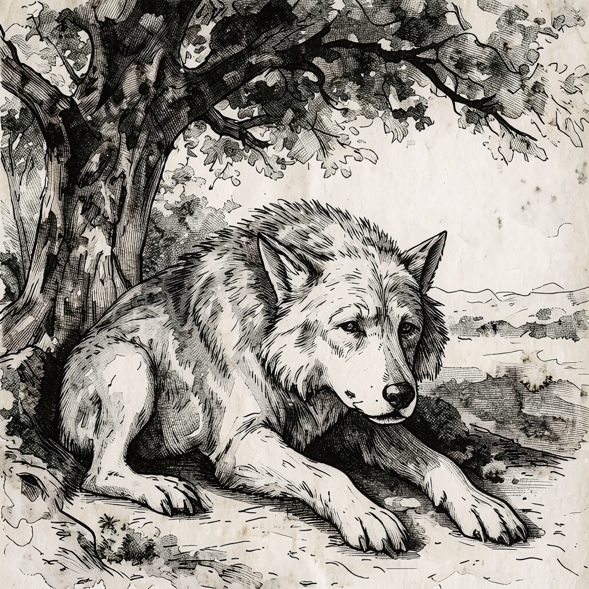
Rialta, the wolf cub, was born by Slievemore, on the island once known as Eagle Island. Although the birth of Rialta was indeed a joyous occasion, tears pricked her mother’s cheeks because her cub had a fur that was a breathtaking blend of cinnamon and creamy white, and she knew it would be prized by the hunter. For in Cromwellian Ireland, bounties were exceptionally high to encourage the eradication of the wolf, and a hunter could receive £5 to £6 for a pelt.

There was great uncertainty in the land; no longer did the trees converse happily with the sky. Now the wind groaned with the story of greed, and it sliced Rialta’s mother’s soul so much so that she felt sorrow for the human.

To appease the ravenous appetite of the new merchants, the land was enclosed and sold. Man, woman and child were removed from Achill and shunted into the bowels of the abyss in the new industrial cities where life moved to the rhythm of the clock rather than the seasons.

One morning, Rialta’s mother awoke to an ominous presence hanging in the air. She paused, the hair of her coat standing to attention. She sniffed and shouted, “Smoke.”

In the blink of an eyelid, the pack in a frenzied rush fled the wolf den. Rialta was grabbed by the scruff of her neck by her mother, who sped towards a nearby Fairy Pool and thrust Rialta into a little snug in the landscape. Then she ran to assist the other members of the pack.

Later, that evening, Rialta peeked shyly from the cave. Sadness weaved around her. It was then that Rialta learned about her mother’s passing. Many of the wolves had died in the fire. She was so overwhelmed by grief that she gave out a mighty howl which cracked the night air.

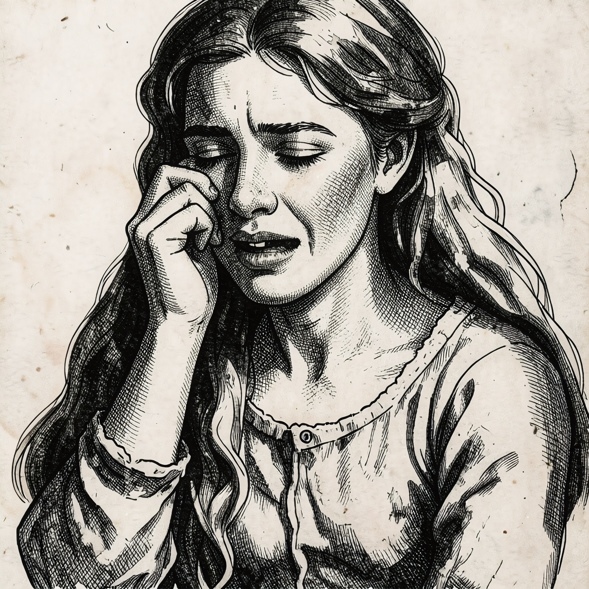
Great sorrow came upon her, and it propelled her further into the dark forest. She ran and ran until she could run no more and eventually toppled, exhausted, onto the ground under an old oak tree. While resting, she saw in the distance a maiden with hair as red as ripe cherries. She was sitting on a tree stump, and she was sobbing.

Although Rialta had been instructed about the devious ways of humans, they were best avoided. She sensed in her heart that this maiden was a kindred spirit. The maiden had the same sorrow as Rialta etched in her eyes. With one faltering step after the other, Rialta made her way towards her.

A cacophony of staccato sobs reverberated around Rialta, and they pained her. Rialta looked down at the girl with the round, sad eyes and discovered that she was a servant girl of the Laird and that her name was Meehan O’Malley, of the great sea-faring clan.

Meehan got no peace from the local Laird. He was cruel, and because she had rejected his advances, he worked her hard. Meehan had the same fierce nature as her ancestor Grace, daughter of the O’Malley chieftain – Owen ‘Dubhdara’ (Black Oak). She was adamant that her youth, her sensuality, was not open for barter to any man. She was determined to get back to her family home in Kildavnet. Her family would be deeply enraged with the way she was treated and knew that this could bring conflict to the island. Rialta and Meehan sat nursing their heartache, tunnelled in the fragments of blurred memories.

Meanwhile, in a droughty type of inn, the hunter McGrory was nursing his wrath with ale. It was he who caused the fire. He had hatched a plan to ignite what he thought would be a controlled fire to smoke Rialta out so he could capture her. His plan had failed; instead of Rialta’s soft coat, he only managed to get four plain grey ones, which fetched one pound less at market. He thumped his glass on the wooden table and resigned himself to the fact that he would resume the hunt in the spring.

Time passed, and soon the stirrings of Spring moved across the land. The increasing daylight hours began to soften the dramatic Atlantic backdrop, with the iconic gorse bushes turning the hillsides a vibrant yellow. One morning, Rialta and Meehan were sitting by a lough eating fresh berries and laughing. The sound of hooves in the distance interrupted their peace.

Both fixed their eyes on each other. McGrory, their relentless adversary, would soon fast on their heels. His presence was looming closer with every passing hour.”

The hooves’ vibration was getting louder and louder. Both Rialta and Meehan jumped to their feet and began to flee.

With whirling adrenaline and heaving breath, they ran and ran, and they ran until they came to the cliffs at Croaghaun on the West Wild Atlantic.

Rialta and Meehan looked at each other and smiled. With minds locked in mutual agreement, they took one firm step and leapt downwards and downwards into the warm embrace of the ocean.

When McGrory reached the cliffs and saw Meehan and Rialta had vanished into the sea, he was furious.

It is said that in their desperate pursuit to remain free, Rialta and Meehan did what only a wolf and an O’Malley woman would do—they ran, unbound, into the sea. It is also said that in times of eviction or trouble, a mysterious wolf and maiden with hair as ripe red cherries would make a ghostly appearance.

And today, there are times when the wind howls loudly, a strange figure of a maiden and a wolf can be seen in the deserted village by Slievermore. A haunting reminder of times passed on Achill Island.

Carol, St Dominic’s, Faith, and I

Carol and I

The empty Cashel Blue cheese packet was evidence of my sorrow. I took one small bite: then one after the other, rotating each morsel around on my tongue. Its creamy saltiness offered solace on a night when I felt a deep loss.

Emotionally drained, I sat in silence, numb, alone in my existential crisis; looking out towards Black Sod Bay where the tide weathered the stones, and the wind whirled, swirled, and whirled again. Stony still I sat, and I reflected on my decision to distance myself from mainstream society for the winter, to allow me time and space for mourning.

2024 was a difficult year. Three good friends died, and their passing created a huge crater of loss in my heart. Their deaths pushed me to a lonely place, which was especially challenging because, as an introvert, I have always lived life with a handful of close friends. I looked forward to the Bells heralding in the New Year, yearning to say goodbye to a year that brought nothing but sorrow. However, January 25th would offer another huge blow; I was given the news that my good friend Carol had died.

Although I do not remember the exact circumstances of our first meeting, our friendship was quickly established. Carol had spent most of her life in mission as a nun abroad, but she had come home to Cork to retire. She was a deeply spiritual woman who bore no resemblance to any of the dour, bleached-faced nuns I knew in my childhood. She was easy to befriend, as we had so much in common.

At that time, I was working in St Dominic’s Retreat Centre in Cork. I genuinely enjoyed that job and never once wished to skip a day during my time there. Thus, it was a wonderful place to work, and at the core was its strong Catholic ethos. Upon reflection, it was working in St Dominics’s that gave me my first exposure back to Catholicism.

Carol was the local church’s facilitator of the RCIA (The Rite of Christian Initiation of Adults), and she asked me to prayerfully consider accompanying a young man on his journey to enter the Catholic Church. Though grateful for the offer, I was cautious. I was being handed a huge responsibility, and I needed time to deliberate, to consider whether I was worthy of such a role.

Despite being Catholic, I had moved over to the Protestant and non-denominational Churches. In the beginning, I felt at home there, and in those early days, I would never have considered giving thought to Mass. My experience of Catholicism appeared to me to be institutionalized, misogynistic, boring, inconsequential, and removed from the “real world.”

However, by the time I had met Carol, I had become disillusioned with Protestantism. I must emphasize that I have no intention of bashing Protestantism. I fully understand that there is no such thing as a perfect church, and in all my years in Protestantism, I observed the genuineness of faith, the commitment to Jesus, and how everyone did their best to live in spirit and truth. However, I experienced a sense of detachment, observing from the periphery even though the congregation welcomed me warmly. I wrestled for a long time with the idea that something must be wrong with me.

My meetups with Carol were the highlight of the week. We would discuss scripture and spiritual matters over tea, and it was during one of our meetings that I realized there was a huge void in my Christianity. That is the life and times of the saints and martyrs.

The churches I frequented didn’t really think much of saints; we were all saints by virtue of our connection to Jesus, called to live holy lives. Hence, I never gave them much thought. Carol spoke about them warmly, and she sparked my interest in their stories.

I love reading autobiographical stories. I love to read how the characters in the stories face their challenges. Life never runs smoothly, and this type of story helps us to navigate the map of our lives. One story is the powerful account of Perpetua, a young noblewoman, and Felicity, a pregnant slave, both women who, despite having differing socio-economic backgrounds, were united by the same faith. Their story is found in one of the oldest Christian texts, ‘The Passion of Perpetua and Felicity.’ It is one of the earliest prison diaries where Perpetua details her arrest and imprisonment before being thrown to the beasts in the amphitheater of Carthage. Perpetua and Felicity’s story was impactful and gave me insight into how precious faith was to both women. Their story showed me that the walk of faith isn’t always an easy journey; sometimes we must stand and carry our cross.

There were many chats over tea, and each time I came away with the desire that I needed to change direction. It was difficult; I struggled because my childhood religious experiences in school and church were negative. That’s the thing with people, we are imperfect and flawed, and yes, I would have to say horrible things have been done in the name of religion by people who have distorted and manipulated scripture to suit their ego in the power search. But at the centre of it all is Jesus, one hundred per cent God and one hundred per cent man – perfect. He wore a crown of thorns so I could have a crown of glory.

One afternoon over tea, Carol invited me to a prayer group which was going to be held at St Dominic’s. I recall that my jacket was no match for the November wind. There were seven of us in what was known as the Green Room. Carol read out scripture, and we sat and meditated on it. I was struck by the peaceful silence. There was no immediacy to get a word of knowledge or even offer wise words. We all sat quietly in a circle, and then an ivory white candle in a beautifully designed votive was passed around. Carol instructed us upon receipt of the candle to offer a short prayer. The prayers may have been short, but they were meaningful and had depth. It was a breath of fresh air to have short, carefully summarized prayers rather than lengthy prayers, which can sometimes wander into a person giving us an opinion or a brief theological lesson. The experience was so beautiful, I cried, and with tears pricking my cheeks, the realization came – I had come home. As rain pounded the streets, I made my decision that I was going to be part of the RCIA group and accompany the young man on his journey towards Catholicism, but I still wasn’t ready to close the curtain on my Pentecostal Church.

The day I said, “I can’t do this anymore,” and walked out was triggered by a minor issue, but it grieved me so much. I walked into a sports hall, the place where the church gathered for its meetings. I slipped into a seat at the back, quietened myself, and prepared for the service ahead. It was during my quiet moment of prayer when I sensed two women bounding towards me who were eager to chat. “Why couldn’t they wait,” I hissed under my breath, “until tea at the end of the service.” I forced a smile, hiding my true feelings. So, there I was faking my feelings, feigning an outward appearance of niceness which was totally false. Then I was stunned into silence. It was the moment I took note of my surroundings: a hall with tinny, hollow acoustics, bare walls, and windows locked from within. Perhaps, if I were in a church with stained glass windows, crucifixes, and carvings, there would be less inclination to come over and chat. Thus, the room did not lend itself to reverence. Despite knowing that it’s the gathering of people that is the church and not the building, I wanted something that resembled a church.

The sound of pitter-pattering on my caravan window brought me back to the moment. Everything sounds louder in a modular home at dusk, and I moved into the sound of the old well by me. Its constant gurgling is like soothing balm for the soul. Carol taught me that if one pauses, nature can teach us a lot, and at that moment, the shapes and shadows of the bog presented themselves, declaring its winter beauty.

It isn’t just water in the old well; life is abundant, albeit dormant in winter. Rain sustains life, cleanses, and replenishes, and the water reflects the Heavens above. Now, I feel comfortable embracing the God of the universe — the One who made the stars and the rivers. For a long while, I worried that my tendency to find symbolism in nature was excessive, as some people in my former Baptist Church cautioned me, I was deviating into Paganism.

St Dominic’s Retreat Centre has since closed, and when I heard this sorrowful news, a knot of deep grief overwhelmed me. Its closure and the death of Carol signaled the end of an era. There would be no more meet-ups, no more visits, and no more walks around the garden. All that I have left are fragments of memories. As I stood looking out over the bog, the loneliness of thinking back to something no more overwhelmed me. The Irish word for this kind of loneliness is ‘cumhaidh,’ a feeling that runs in the blood of many Irish people.

I catch my reflection in the window, and I notice the webs fixed around my eyes. I am grateful that I have a God who shows me goodness through nature. Soon the snowdrops will show, and the beaches here will have people. Winter’s deepest truth is that everything passes, and when the wheel of the year is in winter, it will always turn to spring.

Strong hemming, seams, and buttonholes.

I feel a rant coming on.

I could never be categorised as a model pupil at school. Still, I can remember my home economics teacher saying, ‘A high-quality garment will have strong hemming, seams, and buttonholes.’  In my four years at secondary school, there was so much learning I could have retained, but for whatever unknown reason, the details of strong hemming, seams, and buttonholes stuck in my memory.

This article isn’t about my time at school; it is about how one assertion, which in the first instance may seem inconsequential, holds significance and highlights how we as people have changed.  And all this came to me in a search for lace fingerless gloves, an innocuous endeavour.  

To source the gloves, I had to leave the island.  I visited Westport, Castlebar and Galway, but my search was fruitless.  I had no option but to go online. As usual, the magic of the professional photographer significantly enhanced the appearance of the gloves, which were marketed online. It was evident upon receipt that they are not highly durable.

There was a time when it was considered important to dedicate time, energy, and expertise to crafting good-quality clothing. Quality was linked to self-respect. I recall my grandmother saying to me, ‘People may have had little money, but they took pride in themselves by polishing their shoes.’   Probably said in response to me going out in my unpolished Doc Martens. Once common, this outlook is now outdated. Today, mass production means we have surrendered to buying large amounts of clothing, much of which sags and comes apart after just a couple of washes.

At first glance, the plight of inexpensive clothing might appear totally unrelated to slow lane living.  However, it is the author’s opinion that fast fashion is a bedfellow of life lived in urgency.  There is little time to spend pondering over what to wear, and little time for complexities. Thus, we get up, get dressed and go.  We are encouraged to buy, buy, buy, always in pursuit of the latest trend.  Fashion houses and advertisers employ strategic and innovative methods to cultivate consumer demand by stimulating continual dopamine release associated with acquiring new products for legal markets of mass addiction.  Exhausting.

Nowadays, functionalism is required rather than flair. Functionalism is valued for quick operation, making individuality less common. Additionally, it is more cost-effective to outsource our clothing industry to low paid nearly slaves, who tirelessly operate machines to the incessant speeding of fast-paced whirring.   As time is money, there is little desire to create garments with strong hemming, seams and buttonholes. Complexity slows us down. Therefore, creating something similar tends to yield better results for manufacturers.  And if you do wish strong hemming, seams and buttonholes, one must go upmarket, which will no doubt distress the piggy bank, but the whole process of purchasing will be done in the calming, slow beat of luxury.

Lampposts are no longer manufactured with beautiful, ornate designs, and cars are seldom seen in orange and yellow. We have lost colour and details that create prettiness.  Kitchen equipment is often metallic grey. It’s fit for purpose and easier to maintain, a priority in modern living, but give me the old-fashioned fridge which burrs in the evening.  I love the sound that it makes, it’s a reminder of the welcoming cheer of hearth, though perhaps I’m simply being nostalgic.  

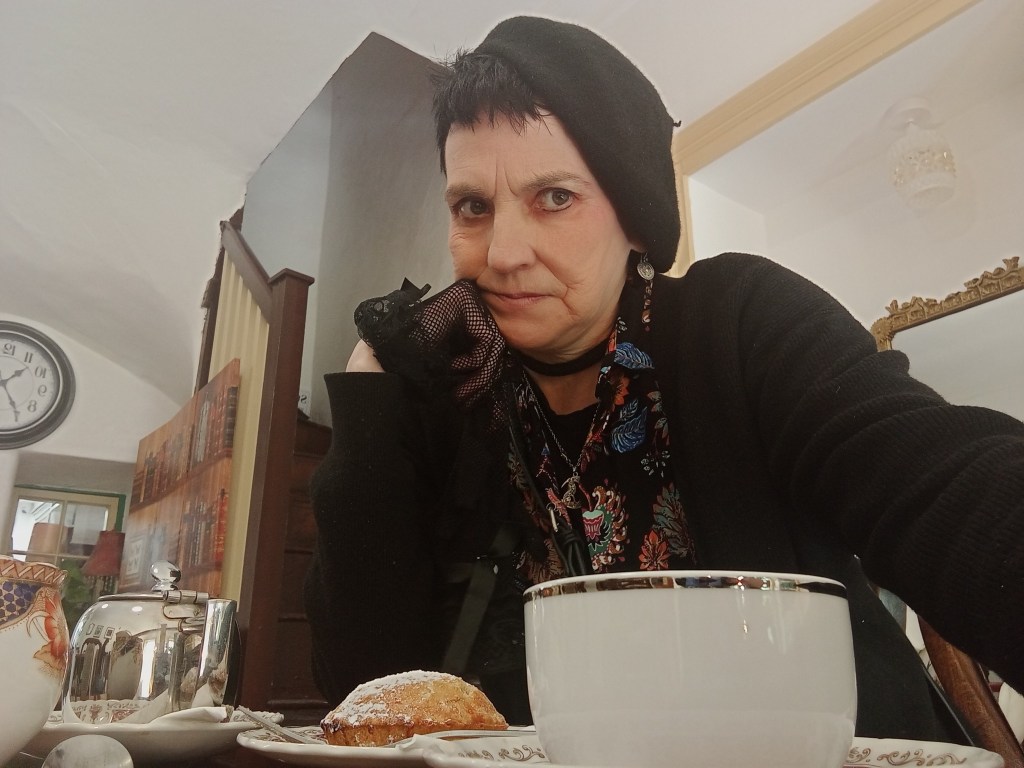
My style is not unconventional, it is rather commonplace; jackets, tops, jeans and dresses are my mainstays. It’s a wardrobe built through time, slowly one piece at a time.   I do like to add fancy tights, lace fingerless gloves and hats – the accessory signature that marks me as ‘Rae’.   

My youth was lived in a landscape of trends. Of course, there were distinct styles that were commonly worn, like puffed sleeve blouses and platform shoes.  However, there was space for people who wanted to ‘rock their own style’, individuals who navigated the many cool offbeat subcultures. Unlike mass-market department stores of today, boutiques offered unique, one-of-a-kind, or limited-run items. Way back then, there were stores one could walk into and come out happy with something just a bit different.

I owned a pair of purple striped harem trousers when Oxford bags were in vogue.  Harem trousers were baggy, elasticated at the top and drawn in at the ankle with an outward ruffle. Think – a trousers version of Andy Pandy’s dungarees. I loved those trousers; they told the story of fun, and there was the extra bonus of being the only person in my town who had them. Yeah, someone did shout ‘poser’ at me in the city centre of Glasgow, but I kept on wearing them.  Why wouldn’t I?  I wasn’t going to be intimidated by words.  

I love daffodils; bright yellow, pretty, the sight of them is soothing balm for the soul.  Now, what if God created only daffodils, and there were no other flowers, no roses, no snowdrops, no lilies? I don’t think I need to expound on this other than to write that while we may admire the yellow blooms, we would miss out on the awe and wonder of carpets of flowers in various varieties and shades. Thus, if God created us unique, each of us with our own exclusive fingerprints, why do we diminish ourselves into relative sameness? Humans are his wondrous creations, and we ought to ‘rock our personality.’  After all, our years are precious, and even if we live to three score and ten, life is too short to hide in the shadows.

Our younger years shape us, and it is no different when it comes to the story of our clothes. This tale is set in my hometown and happened when I was approximately fourteen years old.  Oxfam opened as the first charity in the town, much to my delight. However, there was reluctance by many to enter the store, as assessed by the few people who used it.  Perhaps the ethos of second-hand didn’t tally with the upper social mobility codes espoused by the locals, or maybe many had similar feelings to those of my mother, who grew up wearing hand-me-downs. She wanted new, unworn and fresh off the rails.  Anyway, as a mere youngster who saw it through the lens of discovery, it was an Aladdin’s cave storing an eclectic mix of good-quality items. 

One rainy day after school, sifting through the rails, I came upon a red cape with large ornamental buttons in blue, green, red, and yellow.  In a wisp of a second, it came to me that the buttons would add character to an otherwise dull purple hessian bag I owned. I purchased the cape, cut off the buttons and sewed them on my bag.  I gave the cape to a friend who made a waistcoat out of it.  I was very fond of that bag, and time has elevated that bag as one of my favourites. Those buttons emphasised my daydreaming, whimsical nature and the purple hessian bag, my laid-back hippy vibe. I was granted the opportunity to discover who I might be in the world of garments.

Sadly, I would have to say that many modern-day charity shops have lost that exciting atmosphere of yesteryear.  A wave of sadness comes over me when I see ornaments with chips and scratchy scruffs in footwear. That was never the ethos of that old Oxfam. Moreover, most charity shops nowadays just don’t have what I like.  I don’t blame the charity shop for this, after all, they can only offer what people donate, and donations today will probably not have strong hemming, seams, and buttonholes, which means they may not have the staying power of yesteryear’s clothing, thus designed to be disposed of rather than passed on for donations.

I would be the first to admit that the past was not a rose-coloured utopia. I am aware that it is all too easy to romanticise the past.  However, my lived experience on this Earth has shown me that everyday style has become blander, and sameness abounds.  Strong hemming, seams and buttonholes suggest care and time, something classy, something to be valued.  Do I not deserve more than flimsy and throwaway?   If, like me, you prefer something a bit different from what the masses are wearing, one must go online, which upsets my ‘shop local’ heart. I would like to make it clear I’m not saying professions like the garda should ditch their uniforms, not all, that would be absurd.  My concern pertains specifically to everyday social attire. Uniforms, on the other hand, serve a functional purpose by clearly indicating an individual’s role or identity; their clothing immediately communicates this information without ambiguity.  

Oh, why so much conformity?  Perhaps it is safer not to curate oneself and bear the offence of standing out.  Maybe it shows wisdom by shielding oneself from barbed comments and the whispers of ‘who does she think she is.’  Maybe clothing today purely reflects our busy, busy, busy regime, and I should not expect anything else.  Like fast food, to be eaten on the go, clothing is designed for us to open the wardrobe and go, go, go.  

But let’s not forget that choice is rather limited and we are at the mercy of what the shops stock.  I understand, it’s about supply and demand; thus, if there’s demand, supply follows. However, it could be argued that the systems in place to purchase clothing from suppliers necessitate that department stores must buy in large amounts, and items guaranteed to sell, so it is not viable to purchase smaller numbers, especially when ordering from overseas. This results in clothing which is similar in stores, so one must buy from what is available. This contrasts with the boutique, which can purchase smaller numbers of select items. The boutique can order fewer items, in an economy where many don’t have the income to purchase higher-end clothing, the owner is at the mercy of the department stores.

My rant is rather long, so I shall pause, look at the grey, soggy sky, grateful I do have enough clothes to wear, and I don’t need to be on the conveyor belt of fast fashion.   I can navigate life slowly away from worldly systems that propel me to live life with speed,

Ah, my rant concludes.

In memoriam

Bus Stop, Franx’s, Gear, Lady Jane, Isobel and the boutique in Inverness whose name I forget.

Greta

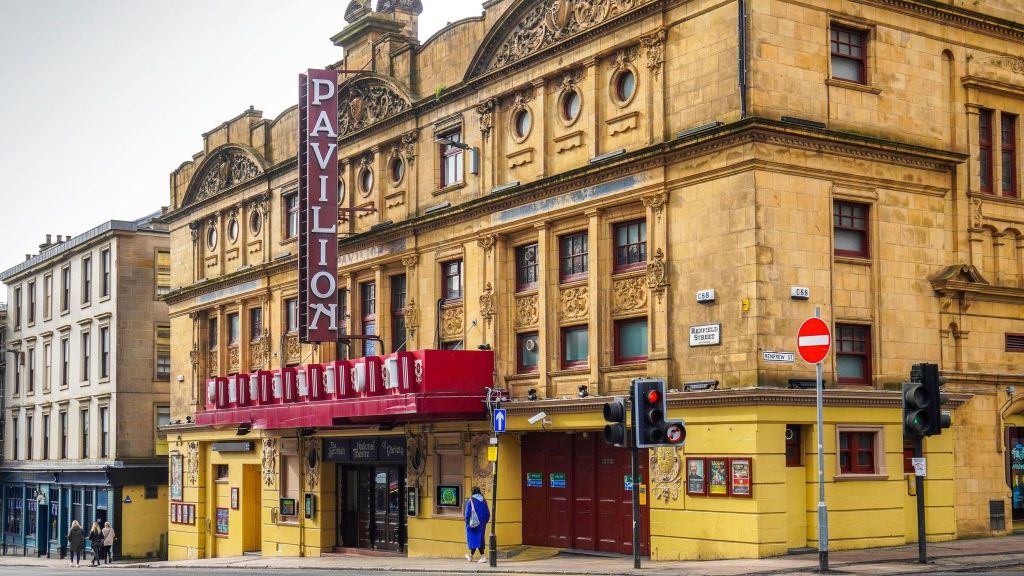
The Pavilion Theatre, Glasgow.

It is another cold and rainy day here in Achill Island, but my heart bursts warmly. It has come to my attention that my journey through life has been one where I have had the pleasure of meeting so many people who have shaped me.

Many of these meetings happened before we lived life wired to the world. Back then, people looked at each other and chatted to each other in cafés and talked on buses. We planned and chatted about community actions, and we danced in clubs and festivals, and it was easy to listen to people’s stories. Listening to people’s stories was an interest of mine. I much preferred to listen rather than chat, and I was always intrigued by the individual who danced through life to a different drumbeat. I desired to find out more about them. Greta was one of those people who had an alternative worldview. She was a wonderful woman who had a huge impact on me.

This personal biographical story takes place in the bustling city of Glasgow back in the nineties, which now seems a very long time ago indeed.

Greta exuded sophistication, packing elegance into her petite 5’1″ frame. Her hair, chic platinum silver, always looked as though she had stepped straight out from the hairdresser. She had a keen eye for colour, and every piece of clothing was carefully chosen.  She knew the precise scarf for her outfit, and she wore it well.  I believe I discovered the concept of a capsule wardrobe from Greta long before it ever became vogue.  

I first met Greta at church sometime around 1995. Although she was in her seventies and I was in my thirties, we struck up a friendship. Greta was a lively jolt of energy despite her elderly years.  

It was a wishy-washy day, the type of weather that the Glaswegian word ‘dreich’ describes so accurately.  Greta was wearing a midnight blue coat, which I later discovered was Jaeger, and she looked comfortable sitting on her own.  Her confident composure contrasted with the lack within me. I have to admit that when I observed her, I desired a portion of that confidence.  She used her slim fingers to slice a portion of the fruit loaf, then she placed a small nibble in her mouth   

Greta loved the theatre. In her younger days, she had ‘tread the boards ‘mainly in musical theatre at The Pavilion.  She had performed with Scottish stalwarts like Edith MacArthur, Harry Lauder and Jimmy Logan.  I listened in amazement as she recounted stories of Glasgow theatre life.  She loved Glasgow with a passion and told me that she was happy to be in the chorus line of a Scottish theatre rather than secure a bigger role in the West End of London.  

            “I’m blessed with my own house. For me, that’s success

Greta’s house, modest by today’s standards, had an Art Deco vibe.  She lived in a room and kitchen with a bathroom in a Super Wally Close. A Super Wally Close is an upmarket tenement with ornate ceramic tiles and stained-glass windows, often in the style of Charles Rennie Mackintosh.  She said living in a tenement made her feel safe rather than living alone in a bungalow up in posh Bearsden.

On my first visit to her home, my eyes widened at the number of collectables she had. She curated a collection of Royal Doulton figurines, each carefully displayed on shelves along one of her walls.  Additionally, there was a mahogany display cabinet with various porcelain teapots, jugs, cups and saucers.

From the moment I stepped in, its cosiness gave me a warm welcome.  She invited me to sit down at her table, where she placed a beautifully embroidered tablecloth over it. Then she set the table for tea.

Tea was poured from a teapot into a cup and saucer.  It appeared to me that Greta possessed considerable expertise in bone china, and her joy was sparked by Royal Albert, Old Country Roses, porcelain tableware.  She certainly would not be impressed with tea in a plastic throwaway cup. 

For Greta, tea was a ritual.  Tea led to unhurried moments, conversation, and human connection.  It was easy to converse with Greta, and I was amazed by her extensive knowledge of music, literature and art.   Greta opened a door into the art world, and with faltering baby steps, I entered.     

One of my favourite memories is when Greta and I went to the theatre. I can remember the evening as though it were yesterday. It was an evening when the city streets were dusted with frost, and we had booked no expense spared seats to see Joseph and the Amazing Technicolor Dreamcoat in the Glasgow Pavilion. It had been years since I had been to a live theatre performance.  During my time in secondary school, I went to see The Sash and The Cheviot, the Stag and the Black, Black Oil.  As I write, I realise I must have had some interest in theatre, otherwise I would not have gone to the Citizens Theatre to see the plays. I would have stayed at home, but for some reason, I chose to close the door, and all I can say is ‘More Fool Me’

It was a wonderful evening, a memory that I love to revisit. I made an effort to dress in a style more suitable for an evening at the theatre. I even discarded my flats for a pair of heels.  Greta had said nothing about dress, but I knew Greta would appreciate my making the effort.  I was aware that in Greta’s world, dressing for an evening at the theatre was mandatory. 

The evening was a joy. As soon as we hit the city centre, we went for a meal. It was scrumptious Italian pasta at the popular Dino’s in Sauchiehall Street, which is sadly long gone, and then the joy of walking into the theatre for a couple of hours, being transported into a colourful world.    It was certainly a significant night.   

After the performance, the days passed slowly, and my mood became sombre.  Without any nagging words, Greta had modelled a way of life that I wanted to move towards.

At that time, I lived a life which was very much toxic.  I was loud and coarse, and it must be said I had little self-respect. My choice of relationships was dire, each one causing bone-shattering grief, and ultimately, peace was a stranger to me. Greta modelled the quiet decorum of self-care and self-respect. I was fed up to the back teeth with chaos.

I also became aware of the barbed comments towards Greta, which irritated me.  She was labelled by many as a pretentious snob. However,  I knew the behind-the-scenes Greta.  She certainly wasn’t stuck up at all. She had an old-fashioned elegance, the codes of which were labelled as snobbery in a landscape where being hard was viewed as cool. I became incensed at the foolishness of judging by appearance only.  The city would have been a better place if there were more Gretas. Now with lived experience, I would advocate for a return to some of the old-fashioned codes of behaviour. They made the navigation of life much sweeter. The revelation hit hard, and so began the shattering of the curse of idolising the hard man and hard woman, and tribal monoculture that elbows out softness.

Of course, like everyone else, Greta had her quirks, and that became evident one day when there was a knock at the door.   She moved towards the door, unlocked the security chain, only to be met by a man in a bright purple and clashing green shell suit, which was fashionable at the time. Greta gave an Oscar-winning act of politeness, but beneath the performance mask, I knew she was rather horrified.    

“If that’s fashion, she mouthed, I fear for the future”

It’s been just over thirty years since my friendship with Greta, and it must be said that it was through knowing her that I made the decision to leave. I had been toying with the idea for some time.

I am very fond of Glasgow, and it isn’t out of the realms of possibility that one day I may return. However, way back then, there was a small group of people who I can only recount as toxic and a bad influence.  Moreover, I wanted to walk away from the old way of me, and despite trying to relate as a better person, I found it rather challenging because people still interacted with me through the lens of a chaotic person. Unfortunately, labels stick.

It became evident to me that I had to move away.  I needed a new, fresh canvas to draw a new picture.   And on 1st April, I left Glasgow to practice a different way of doing life.

Until next time.

Achill, Winter and Aging

I stood a while looking over Black Sod Bay, a hum of grievance in between the gusts of wind and the angry waves. Lenny, an old Mayo pony, lingered happily in the wet jaws of soggy moss. There was no snow yet, not even a light dusting on the Nephin mountains.

November has morphed into December, the air is sharper, and life is lived in the shadows of the shortening day. Shadows are a labyrinth of beauty, where nothing is fully revealed and remains uncertain. I feel at home in the grey shades.

Clouds crept in from the Wild Atlantic, dimming the afternoon. Soon, the landscape would be cloaked in midwinter darkness. I have arrived at the bay, delighted to have escaped from loud, overstimulating grey concrete environments. I wasn’t totally convinced that I was at peace, but here I was waiting for this old year to slip away and bring forth 2026. This year, I won’t be making any New Year’s resolutions, as I have learned they are short-lived.

It’s at the bay that I forget all the inklings which take residence in my mind. I forget about all the complexities of life and surrender to the fury of the waves. It is then that I wonder what message, if any, the bay may be telling me. I turned my gaze back to the path from whence I came. My eyes glanced at the trees stripped bare, and I was gripped by impermanence. The cycle of life, with its constant shifts from the yellow of spring, the pink of summer, the copper of autumn, to the ice blue of winter. So why do I burden myself with silly concerns which, at their core, are inconsequential? A day will come when an exhalation won’t be followed by an inhalation. And in the stillness of the moment, I was grateful to take in the cold, clean air.

Isn’t winter symbolic of ageing? The latter part of the seasons and the elder years. Perhaps, it’s inevitable when one adds another year to life that thoughts move towards one’s own personal winter. The lines on my face have deepened, and my body has settled into manoeuvring at a slower pace. I have lived my Spring, Summer and Autumn; now I have landed in the cold, dark season of winter, and it is certainly chilly. In this vast universe, I have no idea when my winter will end—only God knows, but until that time, I aim to make everyday matter.

I am reminded that, despite the bleakness of the landscape which surrounds me, there is light. The soft glow of twinkling lights which adorn homes, shops and trees casts an enchanting atmosphere that always transports me to another world—a place where time slows down and every moment feels magical. The air is filled with the scent of mulled wine and cinnamon spice. I dislike December, but I equally love it.

I observed a solitary beech tree in the distance. It is not barren; it is holding on to its leaves despite it being December. Its fierce grasp on life gave me a moment of pause. I can relate to it. Isn’t it wonderful, I thought, how nature can speak its wisdom into one’s life if only we can free ourselves from the mad dash of living and surviving.

Since coming to Achill Island, I have stepped into a season of reflection in the hope for renewal. Maybe it’s part of the human condition, a time when old age is lived with a remembrance of life gone by, when days of old are more than days ahead. 2024 was a challenging year of loss, and I totally needed time out, somewhere unfamiliar. In essence, somewhere with a new canvas waiting for brush strokes to create a picture. The canvas remains blank.

The dankness seeped into my bones, and I took a few steps back towards Timmy. His coat is a patchwork of whites and greys and dishevelled by the early morning downpour. His round chestnut eyes fixed on me as if to say, What’s up? “Nothing,” I said in a weary voice and then added, “Why, with a large dry field and shelter, are you happy to stand in the sodden spot in the rain? Timmy, hardy and resilient to harsh environments said nothing, but I pondered that Timmy and I are not so unlike. Haven’t I landed in squelchy spots when I could have chosen more life-affirming areas?

So, what burdened me on that dreary skied afternoon? I had been looking into activities which I could participate in. A cheerful, white-haired woman told me about a walking group. Although I wasn’t particularly interested, before she moved on to mention another group, she added, “Oh, you have to use sticks for this walking group.”

My whole body tensed, and my mouth became tight. My initial reaction – irritation. There is no need for me to use sticks. As far as I am concerned, I am able in mind to make that decision for myself.

Seething inside, I bit my tongue, but it was her next comment which caused me to become rude-red. “I can’t be certain, but I think it’s an HSE mandate.”

Is it really? I mumbled beneath my breath then smiled, pushing my infuriation down into the pit of my stomach.

As I walked home, any resentment I was retaining was taken out on the stony path. Ah, the experts. Experts often claim authority and influence policy based on academic data, and before you know it becomes set in stone. On social media, government ministers seem to address their children—not citizens—about what’s best for us. So, is it best for me to walk with a stick despite being physically able, and I must add it is not as though any of the walks are undertaken on tough terrain. In the wisdom of a so-called expert, I am lumped into a homogenous mass of over-60s who are all physically unable to walk.

But here is the rub, any disagreement on my part opens the door to me being labelled as some deviant woman, in essence someone who just wants to rock the boat or worse, showing off. I have no issue with anyone, young or old, who uses a stick. Why would I? My point is I want to age in my way, and at present, I certainly have no need for sticks, and I am certain that I am not alone in my thinking. I am not fearful of ageing, but rather society’s expectations.

My annoyance softened when, from the corner of my eye, I spied a heron; the sight was like a soothing balm, and my breathing slowed. She demonstrated seamless integration with the river, exhibiting a composed and solitary presence that underscored her graceful isolation. “Oh, heron, I admire your patience.”

I am not suggesting that because I don’t need sticks that I am able to attempt some adventurous endeavour like climbing Mount Everest. Certainly not, I find this applause to someone who has years on them and does something considered out of the ordinary patronising. I am merely asking – stop and discern the person on their own ability.

There are times when I receive too much interest in my style. I am acquainted with a barbed comment or two, maybe three. A whispered hiss about my fingerless gloves, the way I wear my beret, even the shade of nail polish. There’s always the probing question to justify my reason. There is only ever one answer, and it is “because I want to.”

Let me give you an example: some years ago, on a blue-sky summer day, I put a temporary tattoo on my shoulder. I was feeling joyful. As it was Tuesday, I made my way to attend a women’s group. I was looking forward to a cup of tea and a chat. However, about ten minutes into the group, my tattoo was noticed, and it developed into a lengthy conversation. My shoulders became hunched, and slowly, minute by minute, I slid down, down, down into the chair. A tsunami of comments was launched towards me, their words merging into an undecipherable clatter. I am introverted, and I don’t like being the centre of attention. Please don’t suggest that I should slip into a t-shirt and jeans. I love colour, it’s part of my creative inner landscape. Besides, life is too short for explanations over clothes.

The clouds turned slate grey, and the soft pitter-patter turned into heavy darts. Waves crashed with deafening energy against the rocks, forcing plumes of white spray high into the air. “What does it matter?” I shout,” It’s not easy letting go.”

When one does not quite fit with the status quo, it can be lonely. I yearn for acceptance to be seen without the focus on my style and interests. But as I stood at the little quay, it came to me that maybe the season of winter is inevitably lonely.

But the rain, now thick and heavy on my head and shoulders, wakes me: December is Christmas. Thus, December is full of light. I revel in the anticipation and excitement, the Christmas trees, the carols, even the mince pies and hot scrumptious chocolate. It is indeed a time of celebration, and it is at Christmas that I am overwhelmed with gratitude at the birth of Jesus. And as I stood with fingers and toes chilled, I held onto the Christmas gift of hope.

Until next time.

Westport

Recalling November’s Cross-Country

There is something about November which seems to lull me to memory. When the days shorten and the sun courses low, I am permitted to pause.  Here on Achill Island, I am wrapped in the silence of the night closing in.  I am sitting at the window looking out at the darkness. In the distance, I can see a few flickering spotlights, but nothing else.  The night allows me to wander into the labyrinth of my olden days, and such memories have shaped who I am.

November was the month of the dreaded cross-country running.  Back in the days of secondary school, our P.E. teachers took great pleasure in forcing us girls to sprint on the open-air area known as The Moss. The Moss had a natural terrain of grass, mud, dirt, and in November, all things decaying underneath.  I was never a runner; my footsteps could only be described as sluggish, as I staggered over branches torn by the wind from the trees.

Upon reflection, winters seemed colder than today, but perhaps nostalgia has coloured my midwinter memories.  My bygone days are cosy and warm, hot velvet chocolate topped with silky cream, slippery sliding on thin ribbon-like sheets of ice that went on forever. The bumps and bruises are forgotten.

However, the memory of November cross-country running is fixed.  It’s cold and uninviting. The recollection of me, a mere fourteen-year-old, puffing and panting on heavy earth often covered with a thin mantle of frost, still disturbs me.   T-shirts and shorts in a sickly shade of brown designed for further embarrassment were the order of the day.  Cross-country running helped build character, a view espoused by the sergeant majors, oops, I mean to write our teachers, an obvious Freudian slip, and if they hold onto that belief, it surely must be true, but for an uninterested teenage girl, it was torture. Anything that could be likened to attributes of weakness was removed from us, and nothing better than cross-country to achieve it.

If truth be known, I didn’t care if I was labelled a cissy. Not one bit. By year 3, everyone knew I was hopeless at sport, and the only people who mocked me were the PE teachers.  I accepted without fuss that I would be one of the last chosen for team sports, but I felt embraced for my other abilities, like my unique sense of style. So, I was always the last girl to enter the gym block, and the first girl to exit, but on the other hand, I was the first girl to have my transistor radio ready for Alan Freeman and the Tuesday charts. Obviously, I had my priorities right.   

I dreaded all sports, but cross-country was my worst nightmare. I would saunter along the damp, dead leaves to the place of torment.  “Come on, Rae,” my schoolmate Mary would coax as she clipped ahead of me to the starting line.   Mary O’Hara, bright, breezy, with the agile physique of a gazelle.  Oh, how I hated her enthusiasm. She would never understand my agony of soggy socks and fractured nails.

Our P.E teachers were harsh and wise; they planned the route with such exactness that no one could cheat by taking a sneaky diversion.  They also conceived that the route included the steep upward gradient at the end of the course, and I must assert that because cross-country always fell on a double period, we had to run this course not once but twice.  The one question I always wanted to ask – why winter?  Surely, cross-country could be run during the summer, at least the nipping blast of winter wouldn’t ice us over, but upon reflection, I would still have hated it.

By the end of October, the thought of skipping P.E. always came to mind, but I couldn’t skip class for four weeks without bringing attention to my absence. So, for three weeks out of four, I had no option but to face ninety minutes of relentless suffering.  

There is one day that I shall never forget. It was a grey, showery type of morning. The Moss was one giant puddle. Even the bushes complained about the raw wind that stole one’s breath that morning. As usual, I was at the tail end.  Bit by bit, I chugged forward on the lumpy, sodden ground, pushing through the white mist. The course attacked my core and my resolve to continue.   My whole body was blue with the cold. I am not ashamed to admit that I wanted to cry.  With every step, my mood became increasingly sombre but after what seemed an age, I saw the finishing line ahead.   I spied a crowd of girls over the line, and they were waiting for me, the exhausted straggler. I could hear the bellowing tone of our head P.E teacher shouting, “Come on, girls, get a move on, we haven’t got till Christmas.”

I had an ally in a girl called June Fletcher, who was petite and blonde with Bambi-like eyes.  She, like me, despised P.E. and we became kindred spirits bonded by our mutual torment. Breathless and sore, we both came to a gully, which babbled and bubbled over granite rocks. It offered us the choice of running through it or jumping over it.  Neither choice thrilled us. We fixed our gaze upon each other and made the decision that we would jump; after all, we had both made it safely over in the first lap.  

Unfortunately for us, we both lost our footing, twisting and coiling, we curled awkwardly into balls and flopped headfirst into the ice-cold water. The gnarling thorns scratched the skin on my elbows and knees, and my newly feathered hair got tangled in the barbed briars.  June had sustained a deep gash on her knee from the rocks.  My shrieks split the icy air. Then realisation hit hard, I was covered in what I can only describe as a thick paste of slime.  

I was cold, weary, and angry. Breath by breath, half step by half step, I traipsed deeper into the winter wind back to school. I could see that June desperately required some medical intervention.  Her face, gaunt and phantom white.  No real words of concern were offered other than, “You’d best get along to the nurse.” Another girl and I assisted June by giving her our shoulders for support. There are times when silence speaks more than words, and this was indeed one of those times.  June’s moist eyes betrayed the smile on her face. Unlike me, she felt great shame that she, in her own words, ‘was hopeless at sport.” 

As we stepped through the gates, a mass of amused eyes fixed on us. We were two zombie-like figures who looked like we had risen straight from the deepest abyss. My body shuddered at the cold as ice-cold darts numbed me. I hoped that the showers would be warm rather than their usual tepid cold.   My wounds were overall superficial, but of course, I would still have to go to the nurse.   Later in the day, June hobbled into double maths; her knee required stitches. Double P.E and double maths on the same day, no wonder I require therapy.

In my view, cross-country is primarily intended to reinforce social conditioning and to shape individuals in ways deemed suitable for good character.  I think it totally missed the mark with me.  In my case, cross-country made me better at making excuses to avoid it. If cheating were possible, I would have certainly done it—there’s nothing admirable about that.  I fully understand that fitness is essential to well-being, but I would have to add that by no stretch of the imagination was I unfit. I was a willing pupil at my weekly dance classes, and I was rather cool on roller skates.

It’s so easy to have the ebbing and flowing of thoughts here in Achill; a thought flutters into my mind, and then another.  The moon is showing, and the rain is pounding the greying landscape. Living in a caravan at the foot of a marsh certainly has its challenges, especially in winter

If I want clean clothes, which I do, I must travel twice a week to Westport for my laundry, approximately fifty miles each way.  Now that’s a bit of a chore. The wind is knocking into my caravan. She’s loud, and one can’t help but notice her wails. Achill is different; the island captures imagination, and it’s easy to feel that one is inhabiting a time before time.  

Perhaps, without realising, dwindling along on The Moss actually did shape my character.  What I considered agony at the time lay the germinated roots for my character of today.  Perhaps my self-resilience and strategic thinking harken back to that brooding moor.

Yet, my story still contains sadness.  My memory of The Moss is of a miserable landscape.  It was only at a later stage that I began to see the beauty that lay in The Moss.  Somewhere in the middle stands an old silver Beech tree, which often resembles an old woman in a shawl, her branch-like arms holding onto its dried copper-coloured leaves till Spring. And if I weren’t too weary, I would have heard her cheering me on as I passed.

Outside, despite the wind, all is quiet.  Now my thoughts are drowsy.  I will go to my bed and rid my mind of them and wait for sleep to take me. 

Until next time.

Names have been changed for confidentiality and privacy.

A Wind Unlike Any Other

The road to Clew Bay

It was 6.30am in the morning and the landscape was blu-ing with cold. It was the third day of Samhain, and I was standing outside on the rugged ground looking out towards the mist dancing on Clew Bay.  The wind moaned; it was a cold Monday morning, the beginning of the first week of Samhain. Everything is entitled to moan on a cold November Monday.  The clash of fading Autumn leaves tumbling off the trees, falling onto a soggy path, made me pause – a moment of wonder I valued.  

The robins are awake and are transmitting little staccato notes of surprise before offering their first tentative trills to the greying sky. 

I turned my gaze around, and for a moment I was lost in the sight of my white lace curtains, window chimes, and hanging baskets.  It may only be a mobile home, but it is home, and I was happy. 

Much to my astonishment, I was approaching my eleventh month in Achill Island.  I just couldn’t quite believe that something which I thought would be temporary had extended into another winter.   

Despite a wind that never ceases to wail like a banshee with fury on her, and driving, darting rain, the weather brings life to my bones. There’s a wind on this island unlike any other in Ireland, and since I have lived in several places and travelled extensively, I can say that with a modicum of confidence.

My early morning routine includes 100 skips before breakfast, and as I skipped the rich, fragrant, dampness of the landscape, teased my nostrils.  I want to keep the memory of it somewhere safe in my mind for the day when I must move on. The thought caused my feet to become tangled in the rope, but I elbowed the thought away and carried on skipping. For now, I can’t bear to think about the future.  One day at a time, isn’t that what I tell myself? However, I am resigned that nothing lasts forever, and moving on is inevitable.

It was Monday, and Monday mornings are my Better Balance classes in Achill Sound. For someone who trained in dance, my balancing ability is almost non-existent. I made my way into my mobile home to prepare breakfast.   There’s something heartwarming about breakfast in a mobile home.  Perhaps it’s the wide panoramic windows that allow one to be privy to the ever-changing seasons and raw nature. There was the sound of tapping on the window, and it became a heavy pitter-patter. Its rhythm whispered,’all will be well.’ There’s no fast pace here in Achill. In the way we live, our pursuit of progress has disrupted the natural human pace, but with a thankful heart, I have withdrawn from all that.

I clasped two pears and a banana from my fruit bowl and blended them with some strawberry ‘Actimel’ and natural yogurt.  Breakfast is a large bowl of porridge with a substantial dash of salt.  To this day, I can’t get used to sweet porridge. It’s nothing but salt for me.  

As I sat watching the sheep cozying up to each other under a cluster of trees to shelter from the rain, my lips curled into a smile. The sheep always bring a special joy; the sight of their scattiness uplifts my heart. I have reconciled to the fact that when one has sheep for neighbours, flowers in planters outside my home is not an option. The flowers make a scrumptious breakfast for them.

I have arrived at nearly ‘slow’. It’s taken considerable time, but my destination to fully slow is getting closer by the day.

I have always been slow; it is a large part of who I am.  However, society pushes for a fast pace on us; for example, the skill of thinking on one’s feet is upheld as something worthy to have.  Unfortunately, I have never had that skill; my words always seem to come out strangled when I speak.  It is a different story when I write; then I can take time to ponder, and I can take as much time as is required.  A valued skill when one takes a written exam.  I don’t burn bright, I burn slow.

Society has conditioned many to believe that slow denotes limited intelligence, and one does not have a clue about what they are doing, and may require help. There have been several occasions when I must use the self-service machine in the bank in my nearest town, which is approximately fifty kilometres away.   I often get the impression when using the machine that, due to operating at a slow Achill speed, I must be having a problem with it. Ah! Such is life.

It is fair to say that someone with my type of personality trait needs time to mull over concepts, and that is why I am not good at asking questions directly after a presentation. It is not because I am shy and feel inhibited about asking questions. That is certainly not the case.  I need time to join the dots to create an overall picture.

It seems that there’s a part of a deeper instinct in modern life that requires everything to be explained and then labelled if necessary.  We talk in theories, systems, mechanisms, and motivations. There’s a standard that people ought to attain to be considered ‘normal.’ Oh, how the word normal grates? I suspect that somewhere in the Diagnostic and Statistical Manual, there may well be a listing that describes me. However, I do not accept labels, as our society is often too quick to impose definitions or conditions on individuals.   God has made so many different shades of people, just like He has made so many diverse colours in flowers.

I’m not a team outlier; I participate fully, but fast-paced discussions can overwhelm me. This used to cause me significant stress and, of course, affected my well-being. Putting yourself out there is tough for some of us, and not everyone is naturally outgoing. I would maintain that flaws are the currency of being human. Perfection is boring. How can one so slow survive in a world that is so fast without becoming drained?

The twelve months of 2024 were long and weary, so much so that my face became lined and my shoulders stooped low.  I can’t pinpoint when I lost the essence of the real me, but by the end of the year, I was ill, and when I ventured out, I wore a mask, but no longer.

As I write, I am looking out towards the winter sun sparkling on the rain-soaked leaves, a sight much better than fairy lights.   For the first time in what seems a considerable time, I have peace.  A canopy of raven black is covering the landscape, and rather than having to turn on the lights to keep working, I can now retire into the easy pace of the evening.  Perhaps I will have an early night, switch off my computer, and read a book. 

Until next time.

A wet Achill Sound

The Wheel Of The Year Is Turning

Achill Sound

The wheel of the year is speeding towards Samhain, the season of remembrance. November is one of my favourite months, perhaps it’s because when the days shorten and the sun courses low, it allows for reflection and renewal. Memories; the place where my bygone days gather always gives me an invitation to visit at this time of year.

I have always preferred the scents of Spring and Autumn.   I must confess that I don’t like heatwaves at all. Yes, I admit, I am holding my hands up to admit that I am one of those annoying moaning persons when there is too much sun.  At this point I would have to say that it is my opinion that seasons have changed since I was a child. I did like summer as a child but they were less scorching.  I will expand on this in a later post but for now I am reminded of the annual end of October occurrence, the visit to the shoe shop.

October always prompts me to the memory of getting new winter boots. As a child I much preferred boots to shoes. My favourite boots were what I would describe as tufty boots, they were beige, fake fur line and tied up at the front.  Boots allowed better freedom for climbing and a favourite winter pastime – sliding. My tufty boots had the perfect soles for sliding. The latter two weeks in October pavements were more than often dusted with frost. It was also the time when the greengrocer had an abundance of fruit, and my grandmother would bake my favourite treacle scones. A batch of which would be sent over to us.  Oh! the memories of those long frozen slideways of November.  One by one, us children would line up, then tear down a long thin stretch of ice. Of course, there were scraped cheeks, limbs and unfortunately the occasional broken bone. I was fortunate, my only injuries were on my hands, I disliked gloves, but I was always padded up in a hat, coat and boots.  However, we were brave, and no scrape stopped us from having winter fun.  Until that is, some adult, would spoil our fun by destroying our slide by throwing salt on to melt the ice.   

Ah! back to the present, enough of wandering down memory lane. Wisdom would suggest that residing in a rural area necessitates timely preparation for the winter season.

So, with that in mind I went to Achill Sound earlier today, to buy some provisions to store.  Some of the items that I like to keep in storage include lentils, pasta, flour, suet, powdered milk, and although I don’t usually use instant potatoes, I’ve bought some to have on hand just in case. I also purchased tea bags to get through long, tough nights without power. With tea bags I can cope with the long nights at home. I also have books ready in case stormy weather knocks out my WiFi.

Achill Sound is a small town; smaller than many villages I’ve been to, but you can get most of what you need.  The nearest towns are Westport and the county capital Castlebar.   I do not miss living near a large town at all.   I have discovered keeping my shopping simple has allowed me to be far more creative in my cooking and I save money because I have learned to buy only what I need. Nowadays, I always have a pot of soup on my stove, and I love experimenting with different vegetables and ingredients.  My latest creation which is bubbling away on the stove is Cauliflower and Onion. It is so simple to make and very tasty, especially with a slice or two of garlic bread. 

I’ve noted that I will need to order more oil for heating. I certainly don’t want to be sitting with no heat bluing with cold. Brrr, No!   I have also just bought a hi viz vest for walking to the bus stop in the dark and have got easy access to items such as candles, a torch and matches. I have also treated myself to an electric blanket, ah the comforting thoughts of warm nights in bed, listening to the pitter patter of the rain on my windows – lovely.

As my life is simply ordinary there is nothing more but to write about the mundane things. However, I value my life style despite it may be classed as boring. I may be boring, but if so I don’t care. I enjoy my simple life. I have peace. Currently, I spend most of my time working on my comic.  Unfortunately, I have had to revisit my comic, so it is taken longer than I originally thought.  I will go into the reasons further in my next post.

Thus, it is just another day on Achill Island.

Until next time.

In the tea room in the Gift Shop